
2025 C/2025 R3 (Panstarrs)
I got curious about imaging deep space objects (DSOs), but didn't (yet) have the skills to capture them. I got a Seestar 30 smart telescope to ease my path, and was promptly amazed at what this "toy" could do. You just tell it what you want to capture, it goes and finds it, starts collecting single images ("subs") and then stacks them for you. You see the whole process live on your phone: a few minutes in, you think, "I'm supposed to be impressed by this... faint smudge?!?" But with more integration time, the object gets progressively more defined. It reminds me of seeing Polaroid film develop.
Here is an image of the comet 2025/R3 (Panstarrs) the Seestar collected at Sun Lakes State Park. The comet was appearing very very late, so I configured the capture on my phone and went to sleep. When I woke up, the image was waiting for me. I don't think I will ever stop being amazed by this.
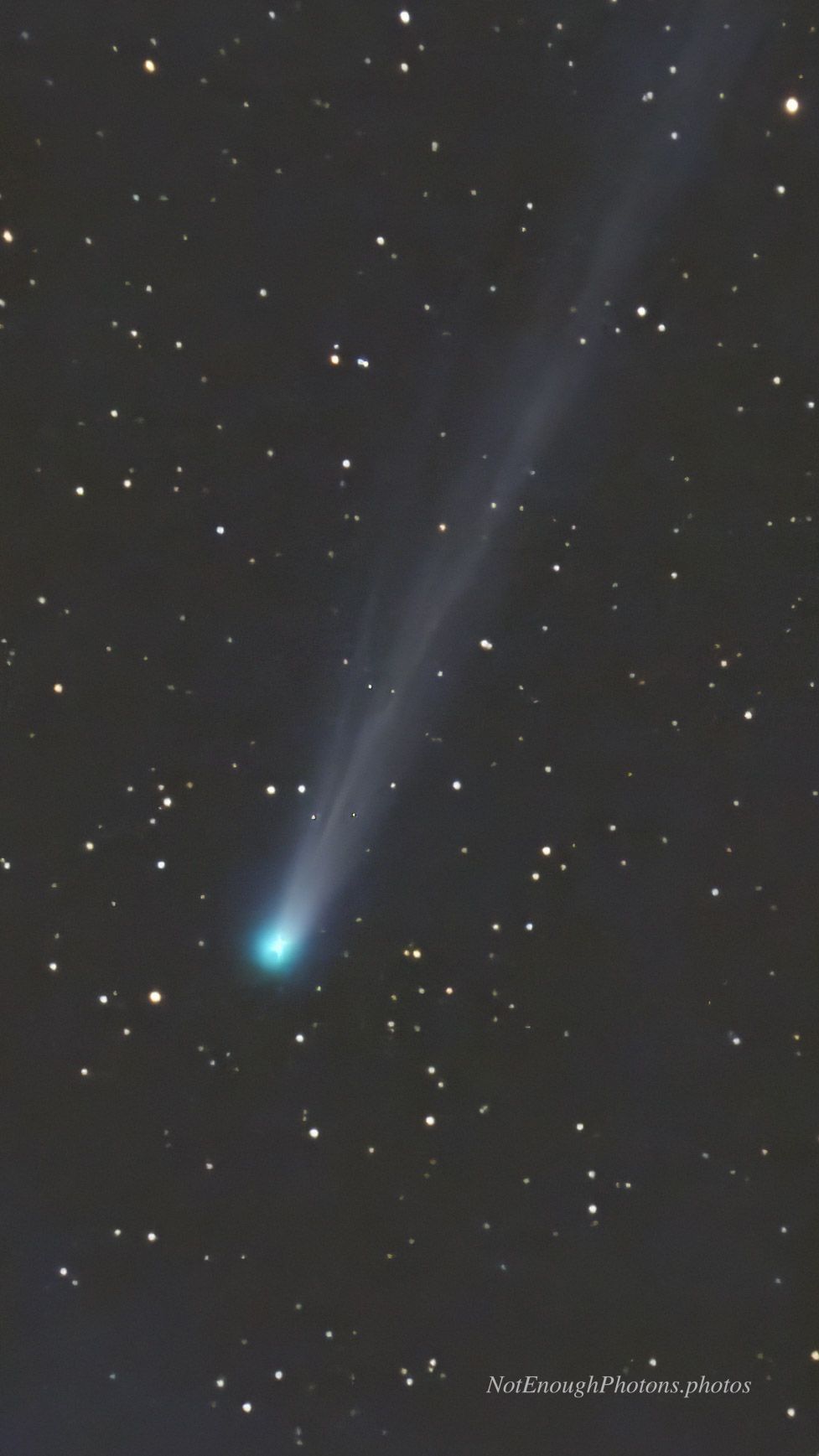
Seestar 30. This is a stack of 83 10-second images, making an integration time of just over 13 minutes. You can often improve the final stacked image by setting the smart telescope to save the individual subs and do the stacking step manually. That's what I did here, saving the final steps and tweaks for Siril astronomical image processing software.
- ← Previous
2024 aurora - Next →
Umatilla Rock star trails